ARTIST Statement
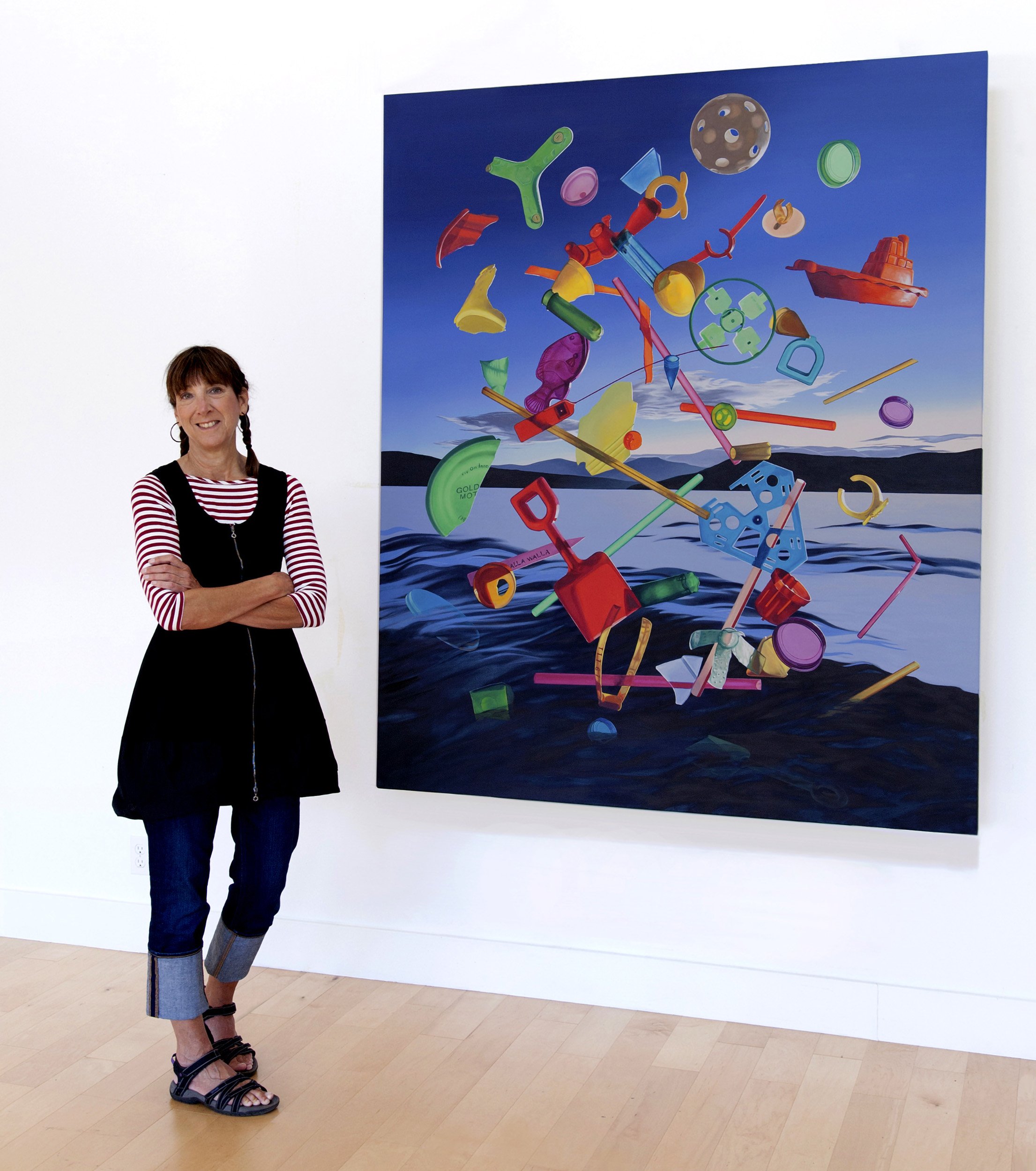
Karen Hackenberg with The Floating World Painting.
As a young child, Karen Hackenberg was excited to go swimming along the shores of Long Island Sound, only to be turned away by a sign that read, “Beach Closed, No Swimming, Polluted Water.” That moment marked a loss of innocence that helped shape a lifelong captivation with the beauty of nature contrasted with the human foibles that degrade it.
Hackenberg’s paintings draw the viewer in with bright colors, playful compositions and masterful technique. Found objects, artfully arranged, occupy the seemingly pristine seascapes of her home on Washington’s Olympic Peninsula. The joy of painting and place is undeniable, and her clever titles offer a tongue-in-cheek interpretation. It is precisely these attractive qualities of Hackenberg’s work, however, that power their subversive intentions. Upon closer inspection, one must confront the paintings’ contradictions. During her walks along the shoreline Hackenberg collects plastic debris found lodged between barnacle-covered rocks. This flotsam then becomes her subjects—jewel-like objects that belie their tragic consequences. Beauty and humor become the veneer for an ugly and very serious calamity.
Each day 2,000 truckloads of plastic are dumped into the worlds’ oceans, rivers, and lakes, indelibly wreaking havoc on delicate ecosystems. Micro- and nano-plastic particles can be found virtually everywhere on the planet, from the top of Mount Everest to the depths of the Mariana Trench, and can even be found in the cells of animals and humans alike. Despite efforts to recycle and reduce its use, consumerist culture’s addiction to plastics keeps growing. The World Economic Forum has estimated that by 2050, the world’s oceans will be filled with more plastic mass than fish.
Facing such horrific realities, a paralyzing defeatism is understandable. Yet Hackenberg approaches her passion for environmental activism with a measured persistence behind every brushstroke on her canvases. The beauty of nature and art become the driving forces that sustain her practice and offer a welcome sense of hope. Hackenberg writes, “Like a raindrop falling on the surface of the ocean, the voice of a single person has the power to effect change, rippling outward to touch and commingle with the many voices of our collective consciousness.”
ARTIST BioGRAPHY
Karen Hackenberg (born Ridgewood, New Jersey, 1955) was raised in a rural town in Connecticut outside of the Northeast’s large urban concrete cities. Here, nature became her playground at an early age. Walks with her father through the countryside fostered a love of the natural world and keen sense of observation. Her father was a package designer, making geometric layouts for cardstock that would be die cut and folded into boxes for various products. Along with being a painting hobbyist, her father instilled a sense of “making” that has followed her throughout her career.
Attending the Rhode Island School of Art and Design in the mid 1970s, Hackenberg pursued the study of painting. Here, she had the opportunity to study in a partner program called Artists for the Environment in rural western New Jersey, which centered an appreciation for conservation of nature through landscape painting. She was able to work alongside artists such as Paul Resika (born 1928) and Gretna Campbell (1922–1987), who became early influences on her art and environmental obsessions.
After graduating, Hackenberg moved to the West Coast where she left painting for a time. Working as a picture framer and then as an architectural model builder, she never left her desire to create. She became a print and textile designer at the Esprit de Corp. Clothing Co. in San Francisco, working on their E-collection line of clothing made from sustainable materials. Echoes from these days immersed in pattern can be found in her recent Unnatural Disasters series.
After moving to the Pacific Northwest in the 1990s, Hackenberg revived her art career and picked up where she left off, painting landscapes. A breakthrough came with the gouache painting entitled Red Tide. After finding a bright orange container of Tide laundry soap washed up on the beach of her Port Townsend, Washington home, she intuitively placed it front and center in a composition with the Salish Sea as its background. The irony of the subject matter brought about a convergence of her life’s interests of art and environmental activism and led to multiple series of works, including the creation of sculptures made from matchsticks that address deforestation and echo her career as a model builder.
Hackenberg represented by Rebecca Hossack Gallery, London, UK, and Patricia Rovzar Gallery, Seattle, WA, USA. She exhibits internationally and her work has been acquired by many private and permanent collections including Portland Art Museum, Tacoma Art Museum, New York State Museum, Washington State Art Collection, Bainbridge Island Museum of Art, and The Allen Family Art Collection.